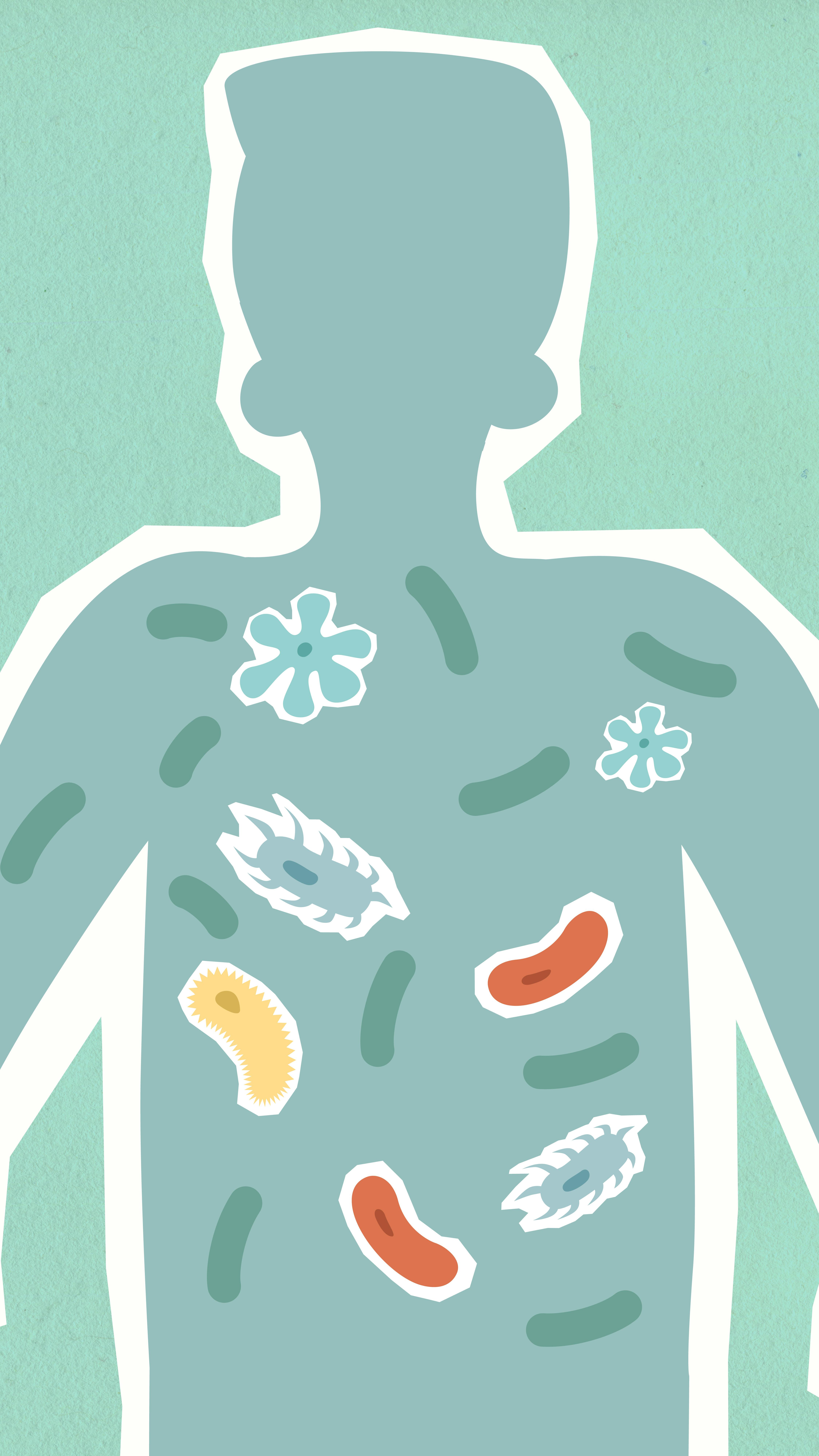
A high-fiber diet barely moved the rectal microbiome, except for two CRC-linked bacteria
A four-year randomized trial found that a rigorous high-fiber, high-produce, low-fat diet had almost no effect on the bacterial community living in rectal tissue, but two oral-originating bacteria previously tied to colorectal cancer dropped more in the diet group than in controls.
A four-year randomized trial that put hundreds of adults on a rigorous high-fiber, high-produce, low-fat diet found the intervention had almost no effect on the bacterial community living in rectal tissue. The null result, published in the Journal of the National Cancer Institute, is a sobering finding for the popular idea that diet alone can remodel the gut microbiome in ways that meaningfully change cancer risk. Two bacteria did move, though: Porphyromonas and Prevotella, both oral-originating species previously tied to colorectal cancer, dropped more in the diet group than in controls.
The study, led by Doratha A. Byrd at Moffitt Cancer Center with co-senior authors Rashmi Sinha and Emily Vogtmann at the National Cancer Institute, reanalyzed biopsy samples from the Polyp Prevention Trial (PPT). The PPT was a multicenter randomized controlled trial that ran from the early 1990s into the 2000s, originally designed to test whether a diet overhaul could prevent colorectal adenoma recurrence in people who had already had polyps removed. The primary adenoma endpoint was negative. But the trial left behind a biorepository of preserved tissue that now lets researchers ask different questions with newer tools.
How the study was designed
The 455 participants, all adults older than 35 with at least one adenoma removed within six months of baseline, were randomized to either an intensive dietary intervention or a control arm that received standard dietary guidance. The intervention had three numeric targets: at least 18 grams of fiber per 1,000 kilocalories per day, at least 3.5 servings of fruits and vegetables per 1,000 kilocalories per day, and no more than 20 percent of daily calories from fat.
Adherence was substantial. Over four years, the intervention group met an average of 5.2 of the three goals across repeated assessments, compared with 1.2 goals in the control arm (P less than .001). Controls received general guidelines from the National Dairy Council without behavioral support.
The microbiome analysis used 16S rRNA gene sequencing on rectal biopsy samples collected at baseline, year one, and year four. The biopsy approach is the methodological story here. Most diet and microbiome studies rely on stool samples because they are noninvasive and easy to collect. Stool reflects the luminal contents passing through the colon, not the bacteria physically attached to or embedded in the intestinal wall. Rectal tissue biopsies capture the mucosa-associated community, which is plausibly more relevant to colorectal carcinogenesis than what shows up in a fecal sample.
What the trial found
Across every measure of microbial diversity, the result was a series of non-significant differences. Alpha diversity metrics (observed ASVs, Shannon index, Faith phylogenetic diversity) showed small, directionally inconsistent changes in the intervention arm, none approaching statistical significance. Beta diversity, which captures compositional differences between groups, was similarly flat across Bray-Curtis, unweighted UniFrac, and weighted UniFrac metrics. Translated: the high-fiber diet did not reorganize the bacterial community structure at the rectal mucosa in any detectable way.
Byrd and colleagues then tested a panel of bacteria they had selected a priori based on prior associations with colorectal cancer risk, diet, or both. Most of these taxa did not respond to the intervention either. Two did.
Porphyromonas relative abundance dropped more in the intervention group than in controls at both year one and year four. The absolute effect was a decrease of 0.24 standard units at year one (standard error 0.07; P equals .004) and 0.12 at year four (SE 0.07). Prevotella followed a similar pattern: an effect of negative 0.40 at year one (SE 0.14; P equals .01) and negative 0.32 at year four (SE 0.15).
Those numbers are modest in absolute terms but statistically robust, and the bacteria involved are notable. Both Porphyromonas and Prevotella are typically abundant in the mouth and have been identified across multiple studies as enriched in colorectal tumor tissue relative to healthy adjacent mucosa. The authors describe them in the discussion as “2 oral-originating bacteria that were previously associated with colorectal cancer presence.” That a dietary intervention nudged them downward, even slightly, in the opposite direction from their cancer-associated pattern is the paper’s most provocative signal.
The researchers also looked at subgroups. Among the 48 participants classified as super-compliers, those who met all three dietary goals across most assessments, the Porphyromonas and Prevotella reductions were directionally similar but no longer statistically significant, almost certainly because of the smaller sample. More striking was the fat-goal adherent subgroup: among participants who consistently kept fat below 20 percent of daily calories, Fusobacterium showed a significant decrease at year four (effect size negative 1.04; P equals .01). Fusobacterium nucleatum is perhaps the best-established bacterial link to colorectal cancer in the literature, so any signal that diet can push it down is worth taking seriously.
Why tissue, not stool
The tissue-versus-stool distinction matters more than it sounds. Most of the large diet-microbiome trials in humans (PREDICT, the DIRECT-PLUS analysis of the DIRECT trial, various fiber supplementation RCTs) measured stool. Stool is convenient, but it is a mix of shed mucosal bacteria, transient food-associated microbes, and luminal residents that may never touch the epithelium. If the question is cancer risk, the mucosal community is the one that interacts with colonocytes, influences local inflammation, and sits at the site where adenomas form. It is also the layer where commensals like Akkermansia muciniphila have attracted years of metabolic and barrier-function attention, although it is the oral-originating taxa that turned up here.
The PPT reanalysis is among the first to ask, “Does a sustained dietary change shift the tissue-resident microbiome over years?” The answer from this dataset is: not much. The stability of the mucosal community in the face of a fairly aggressive diet intervention suggests either that the tissue microbiome is homeostatically regulated, that four years is not long enough to shift it, or that diet alone cannot override the host and environmental factors that shape which bacteria colonize the gut wall.
The authors acknowledge a key limitation: PPT enrolled adults who had already developed adenomas. Whether the same findings apply to a population with no history of colorectal polyps is unknown. They also note that 16S sequencing captures genus-level resolution at best. Metagenomic sequencing, which can identify species and strains and characterize functional gene content, might reveal diet-responsive shifts that 16S misses.
What it means for diet and cancer prevention
The study does not say fiber and produce are useless for colorectal cancer prevention. Epidemiologic evidence linking high-fiber diets to lower CRC risk remains substantial, and the mechanisms proposed (reduced transit time, dilution of carcinogens, production of short-chain fatty acids like butyrate) do not all require a gut-community restructuring. Butyrate, for instance, is produced when gut bacteria ferment fiber, and it serves as the primary energy source for colonocytes while also acting as a histone deacetylase inhibitor with anti-inflammatory properties. That pathway can function even if the overall microbial composition stays stable.
What the PPT reanalysis does is sharpen the focus on specific taxa and dial back the assumption that a diet shift will visibly reshape the tissue community. Porphyromonas and Prevotella may be worth targeting in future intervention studies, and researchers may want to measure them in trials that pair diet with prebiotics, probiotics, or postbiotic metabolites. Diet-only studies for IBS already show that different patterns produce different symptom outcomes through partly microbial mechanisms, so the tools to design those follow-up trials exist.
The take-home is that a healthy diet’s benefits for the colon probably work through several routes, and tissue-microbiome remodeling may not be the dominant one.
References
- Byrd DA, Gomez M, Hogue S, et al. Effects of a high-fiber, high-fruit and high-vegetable, low-fat dietary intervention on the rectal tissue microbiome. JNCI: Journal of the National Cancer Institute 117(6):1237. 2025. https://academic.oup.com/jnci/article-abstract/117/6/1237/8029133
- Schatzkin A, Lanza E, Freedman LS, et al. The Polyp Prevention Trial I: rationale, design, recruitment, and baseline participant characteristics. Cancer Epidemiology, Biomarkers & Prevention 5(5):375-383. 1996. https://pubmed.ncbi.nlm.nih.gov/9162303/
Dr. Kiran Patel
Clinical researcher covering the gut-brain axis, probiotics, and metabolic health. Reports from Boston.
More from Gut Health

Akkermansia muciniphila: what the evidence actually says about the internet's favorite probiotic
Starch- and sucrose-reduced diet tops low FODMAP for IBS symptoms in network meta-analysis