A Patch That Reads Hidden Stress — and Why Five Signals Beat One
Northwestern University engineers have developed a soft, skin-interfaced patch that monitors five physiological signals simultaneously to detect stress in real time — including in infants who cannot communicate their distress.
Stress is a shape-shifter. It arrives as a racing heartbeat, a shallow breath, a palm that goes damp without warning. For decades, though, the only way to catch it in the act was to strap someone into a tangle of wires inside a climate-controlled lab — a setup stressful enough on its own to muddy the very signal you are chasing.
A team at Northwestern University, led by John A. Rogers, has spent years trying to change that equation. Writing in Science Advances in May 2026, they described a device that manages something no commercial wearable has pulled off: tracking five distinct physiological signals at once from a single soft patch smaller than a postage stamp, then fusing them into a real-time readout of hidden stress (Kim et al., Science Advances, 2026).
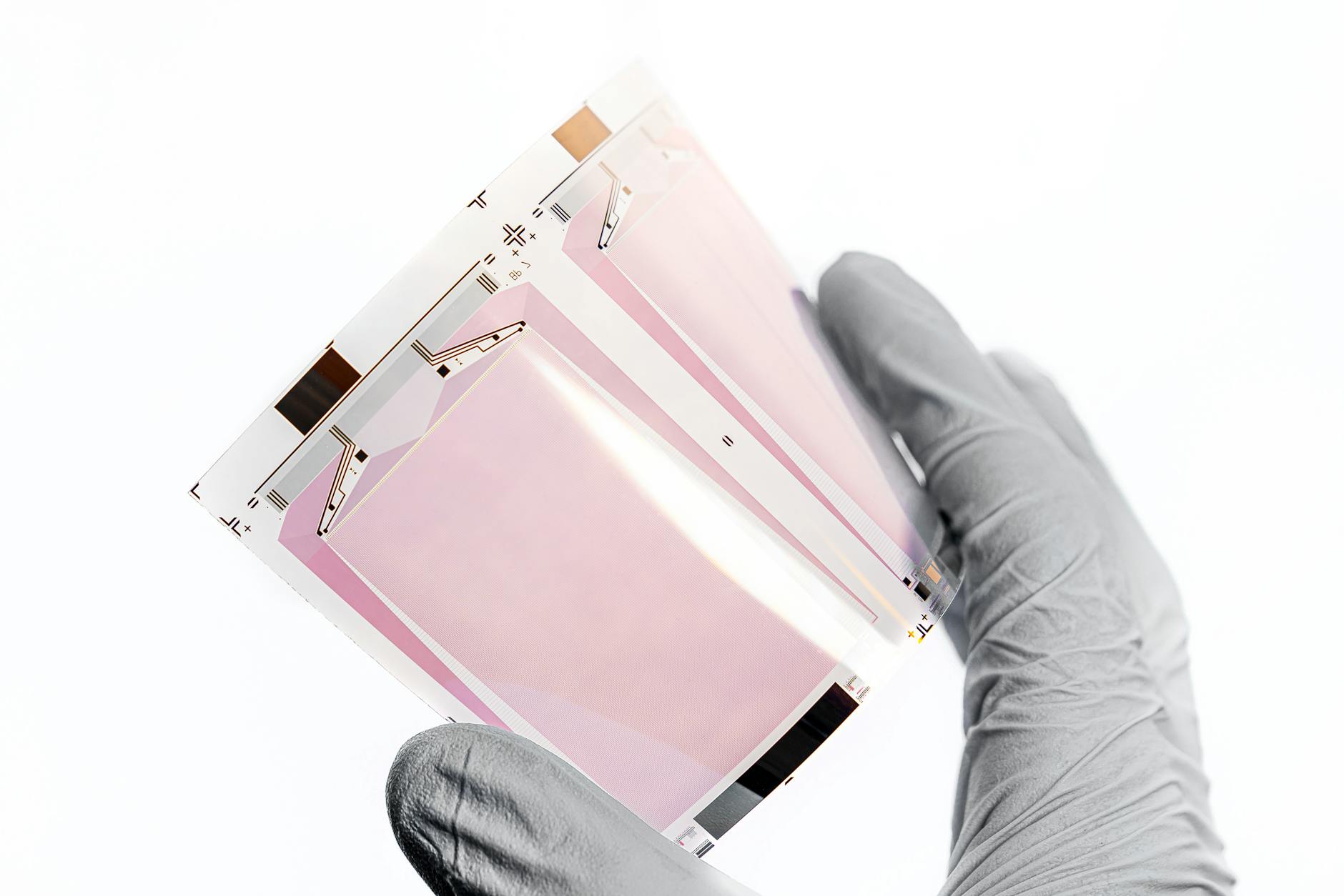
They call it SIMSS — skin-interfaced multimodal sensing system. The whole thing weighs 7.8 grams, about as much as eight paperclips, and runs for 37 hours on a charge. In its first validation round, it picked deceptive answers apart from truthful ones with 94 percent sensitivity and 90 percent specificity during a polygraph-style interview.
“Sometimes, the body manifests signs of stress before a person is consciously aware of it,” Rogers said.
That gap — between what the autonomic nervous system is doing and what a person can consciously report — is where the clinical promise of SIMSS lives. It matters most for patients who cannot tell you they are in distress: a premature infant in a NICU, a nonverbal child with a neurodevelopmental condition, an elderly person surfacing from anaesthesia.
Dr. Debra E. Weese-Mayer, a paediatric autonomic medicine specialist at Lurie Children’s Hospital and co-corresponding author on the paper, put it plainly: “This new device tracks the body’s stress signals around the clock, helping quantify how long someone is stressed each day and how intense that stress is.”
Why five signals, not one
Physiologically, stress isn’t a single event. It recruits the sympathetic nervous system, the hypothalamic-pituitary-adrenal axis, and a cascade of peripheral shifts — blood vessels tightening, sweat glands firing, heart rate climbing, breathing growing shallow — all unfolding on different timescales across different tissues. Trying to read stress from a smartwatch that tracks only heart rate is like trying to reconstruct a conversation from one side of a phone call.
“Measuring stress is a complex task because it’s multi-dimensional,” Rogers said. “It’s not possible to reliably determine stress by measuring just one or two, or even three or four, parameters. A broad collection of factors is necessary.”
That conviction drove the engineering. SIMSS captures five streams in parallel: electrocardiography for heart activity, a chest-mounted accelerometer and impedance sensor for respiration, electrodermal activity for sweat-gland response, infrared photoplethysmography for peripheral blood flow, and a thermistor for skin temperature. All five channels feed into a single flexible circuit board encased in soft silicone, shaped to sit against the sternum without the kind of adhesives that irritate skin during extended wear.
The system’s real edge emerges in the fusion step. A k-nearest neighbour classifier trained on all five data channels issues a single call — stressed or not stressed — by weighing each signal against the others. Benchmarking multimodal classification against any lone channel produced a stark result. Electrodermal activity by itself, the stress biomarker most common in consumer wearables, managed just 52 percent sensitivity at detecting the physical stress of a cold pressor test. Fusing all five channels pushed sensitivity to 97 percent and specificity to 99 percent.
A 45-point swing is not a rounding error. That is the gap between a device that guesses and one that detects.
Four validation contexts, one patch
The Northwestern team didn’t stop at a single lab stressor. They put SIMSS through four separate contexts, each designed to probe a distinct flavour of autonomic activation.
First, a mock polygraph interview. Sixteen healthy adults fielded a mix of neutral and sensitive questions — “Did you take something from the office?” — while a trained polygraph examiner ran a traditional comparison-question test alongside. SIMSS hit 94 percent sensitivity and 90 percent specificity at sorting sensitive from control questions, tracking the examiner’s ground-truth with consistency that surprised the research team.
Second, a cognitive-load task built around the Stroop colour-word interference test, where participants had to override automatic reading reflexes. The device picked up the subtle autonomic signature of cognitive strain — the slight pause, the skin-flush, the heart-rate bump — that comes with a brain labouring against its own wiring.
Third, a cold pressor test: hand submerged in ice water, eliciting a pure physiological stress response with no cognitive overlay. This was the trial where single-channel EDA slumped to near-chance levels and multimodal fusion pulled decisively ahead.
Finally, an overnight stay in a paediatric sleep laboratory. The study population: infants with Down syndrome, a group at elevated risk for sleep-disordered breathing and autonomic dysregulation. These problems often go undetected — not because the condition is subtle, but because standard polysomnography is so burdensome. Gold-standard sleep studies involve dozens of electrodes glued to the scalp and face, belts around the chest and abdomen, nasal cannulas that small children instinctively tear off. Many families decline the test altogether.
SIMSS replaces all of that with a single patch on the chest. Measured against polysomnography as the reference standard, the device caught cortical arousals — the micro-wake-ups that shred sleep and drive daytime impairment — with 98.6 percent sensitivity. Hypopnea episodes, where breathing turns dangerously shallow, were flagged at 97.5 percent. Oxygen desaturation events registered at 98 percent. Urination events, a physiological stressor that reliably fires the autonomic nervous system, triggered at 100 percent sensitivity.
Those figures carry real clinical weight. A missed arousal or an undetected desaturation can add up to days of accumulated sleep debt in a developing brain already navigating the challenges of Down syndrome. If SIMSS reaches clinical translation — Rogers has estimated an 18-month pathway through a 510(k) clearance as a class II medical device — paediatric sleep medicine could pivot from an episodic, lab-bound model toward something closer to continuous monitoring at home.
What the device cannot yet do
Impressive as the results are, the paper wears the marks of a first-generation study. Sample sizes were tight: sixteen adults in the polygraph and cognitive-load experiments, and a single-digit count of infants in the sleep study. The classifier was trained and tested on the same dataset — no prospective validation in an independent population yet.
Movement artifacts — a familiar headache for skin-interfaced sensors — are acknowledged in the paper but not fully quantified across all five channels under real-world conditions. Anyone who has worn a chest-strap heart-rate monitor during a run knows how fast a clean signal can turn noisy once the body starts moving.
Stepping beyond this single paper, the wider wearable-sensor literature offers its own reasons for caution. A 2025 review in Communications Medicine examined multimodal stress-detection systems across lab and field settings and found the performance edge of sensor fusion often shrinks considerably outside controlled environments (Nature Communications Medicine, 2025). Signals degrade from motion, ambient temperature swings, and electrode-skin coupling drift. The SIMSS team will need to show their five-channel approach stays robust when subjects are, say, walking down a hospital corridor rather than lying still in a research-grade sleep lab.
A deeper puzzle lingers too. The device detects autonomic activation — but it cannot tell fear from excitement, physical exertion from emotional distress, or the stress of a cold hand from the stress of a difficult memory. A firefighter entering a burning building and a parent receiving a frightening medical call might produce near-identical autonomic signatures. Calling both “stress” in the same clinical sense risks flattening an experience that is, as Rogers himself noted, fundamentally multi-dimensional. The classifier is a gate, not an interpreter.
Why the engineering matters
Set the caveats aside and the paper’s real contribution snaps into focus. For a century, stress research has drifted toward whatever is easiest to measure: cortisol in saliva, heart rate on an ECG strip, sweat on a fingertip electrode. Each proxy got treated, implicitly or explicitly, as a stand-in for the entire stress response.
The SIMSS paper pushes back against that assumption with data. Five streams outstripping one by a margin of 45 percentage points in sensitivity — and a single-channel approach performing no better than a coin toss on a cold pressor test — shifts the burden of proof. No longer “why do we need all five signals?” but “what have we been missing by relying on just one?”
Both clinical and consumer pathways appear explicitly in the paper. The clinical route — cleared as a 510(k) device for specific indications such as sleep-disordered breathing screening or stress monitoring in non-communicating patients — would place SIMSS in NICUs and sleep clinics. The consumer route, facing a lower regulatory bar, imagines a patch worn during a workday or a tense conversation, streaming data to a phone app.
Neither pathway hinges on the novelty of the sensors alone — flexible electronics and soft biosensors have been advancing steadily for a decade. What makes the case credible is the completeness of the signal set and the body of validation behind it. SIMSS doesn’t promise to decode the mind. It promises something more modest and, in clinical terms, more immediately useful: a wearable that can tell you not just that your heart rate is elevated, but that your breathing has shallowed, your peripheral blood flow has dropped, and your sweat response is activating in a pattern that matches, with high probability, a state of covert autonomic strain.
Whether it delivers depends on the next batch of studies — larger, longer, conducted outside the lab, with prospective validation. The Science Advances paper makes a credible case that the engineering is ready. The evidence base will take longer.
References
- Kim SH, Park TW, Cho S, et al. Wireless, skin-interfaced multimodal sensing system for continuous psychophysiological monitoring — a wearable polygraph device. Science Advances. 2026. https://doi.org/10.1126/sciadv.aed3162
- Review of multimodal stress-detection systems across laboratory and field settings. Communications Medicine. 2025. https://www.nature.com/articles/s43856-025-01234-6
- Lurie Children’s Hospital. Improved wireless sensors to monitor babies in neonatal intensive care. 2025. https://www.luriechildrens.org/en/news-stories/improved-wireless-sensors-to-monitor-babies-in-neonatal-intensive-care/
The Vitalspell brief
Evidence-based supplement science — weekly in your inbox.
Subscribe