Cold Plunges and Your Brain: What the Science Actually Shows
Cold plunges trigger a measurable surge of noradrenaline and dopamine, but the RCT evidence for long-term mental health benefits is still thin. Two recent studies clarify what the data do and do not support.
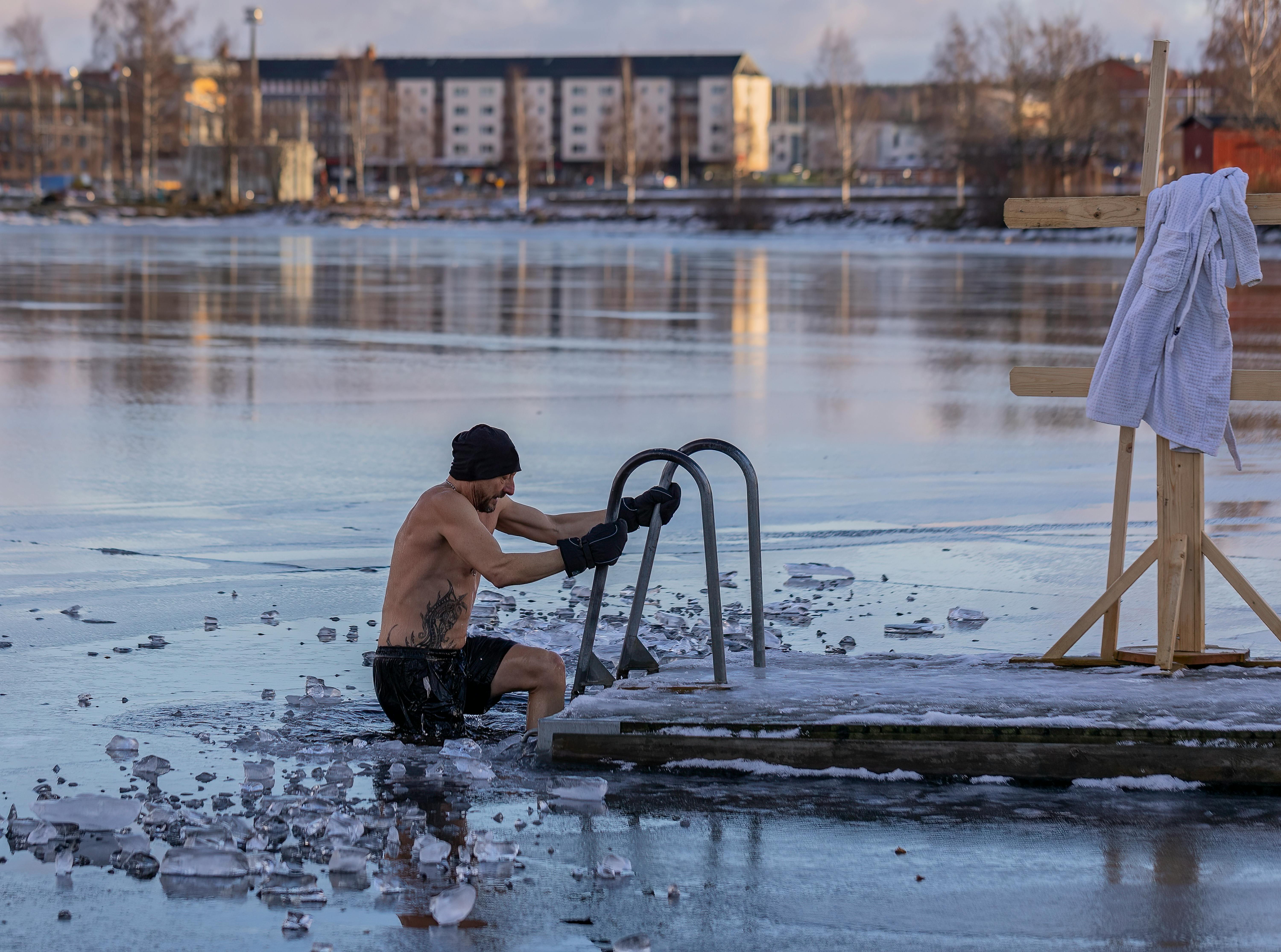
Cold plunges went from Nordic thing to Hollywood thing fast. Harry Styles does it. LeBron does it at 6:30 a.m. before games. Lady Gaga says it helps with fibromyalgia. David Beckham films himself in the ice and posts it. The testimonials pile up. But for a long time, the neuroscience was thin. A few studies have landed recently that actually measure what happens inside the brain when you hit the water. What they found is less dramatic than the marketing. Also more useful.
Cold shock sets everything off. Skin temperature drops, cold receptors in the dermis fire, and a sympathetic volley hits the brainstem in seconds. The locus coeruleus, the brain’s noradrenaline hub, lights up. The hypothalamus releases CRH. The adrenal medulla pumps adrenaline. What you get is a catecholamine flood that, anywhere else, looks like fight-or-flight. Lopez-Ojeda and Hurley catalogued the whole cascade in a 2024 review for the Journal of Neuropsychiatry and Clinical Neurosciences. Dopamine, serotonin, cortisol, norepinephrine, beta-endorphins. All of them spike during immersion and stay up for minutes after. They called the phenomenon “neurohormesis.” The idea: a controlled stress, dosed right, strengthens the systems it briefly knocks off balance.
So how big is the spike? Noradrenaline went up 127 percent after a morning ice bath and 144 percent after an evening one, in a 2025 crossover trial Braunsperger and colleagues published in Scientific Reports. Small study: 12 healthy adults, six women and six men, average age 26. Five minutes in 8 to 12 degrees Celsius water, two sessions per person, one morning and one evening. Blood draws at baseline, right after, and 30 minutes later. Noradrenaline jumped from about 390 picograms per millilitre to over 900 and stayed elevated regardless of time of day. Dopamine is trickier to pin down. The 250 to 500 percent increase numbers floating around come from observational data, not controlled trials. Directional, not precise.
Cortisol is where the marketing runs ahead of the data. In the Braunsperger study, morning cortisol sat at 179 picograms per millilitre before immersion versus 91 in the evening. That is normal circadian rhythm, not cold exposure. The ice bath did not push cortisol beyond what the body’s internal clock already dictated. So the widespread claim that cold plunges “reset” or “balance” cortisol lacks evidence from the best-controlled study we have. What repeated exposure may do, per a 2025 systematic review protocol by Schepanski and colleagues from Charite Berlin, is gradually mute the cortisol spike over time. That pattern would be consistent with hormesis. But the review has not reported results yet. It is registered as CRD420250654531 in PROSPERO. It will meta-analyse cold water exposure RCTs for depression, anxiety, stress, and well-being. Until those numbers land, the cortisol-reset story is speculation dressed as certainty.
One other Braunsperger finding: morning ice baths raised circulating plasma fatty acids more than evening ones. The authors pinned this on circadian regulation of lipid metabolism. If you are plunging for metabolic reasons, the time of day probably matters. The study also found no sex differences in any hormonal or lipidome response, a useful null in a field fond of invoking sex effects without data.
What should you actually do? Frank Lipman, chief medical officer at The Well, says start with 30 seconds and build to three to five minutes, water at 50 to 60 degrees Fahrenheit. The physiology backs this. Noradrenaline peaks inside five minutes and levels off. Longer sessions do not buy you a bigger neurochemical response. They do buy you a higher risk of afterdrop, the continued core cooling that continues after you get out. Do not aim for Wim Hof extremes at the start. The studies use whole-body immersion to the neck. Cold showers probably work similarly but nobody has run that trial.
Some people should stay out entirely. Prashant Rao is a sports cardiologist at Beth Israel Deaconess, the Harvard teaching hospital. He told Harvard Health Publishing he is “pretty cautious about recommending cold-water therapy.” His rationale is straightforward: exercise delivers most of the same benefits on a far larger evidence base. He specifically warns against cold immersion for anyone with cardiovascular disease or heart rhythm issues. Cold shock jacks up heart rate and blood pressure sharply. For someone with compromised vessels, that spike can turn into a medical event. Rao also flagged the post-exercise cold therapy data: the little evidence available suggests it blunts muscle power and strength gains. If recovery is the goal, cold water may work against you.
And does any of this last? The neurotransmitter spikes happen. You can measure them. You can reproduce them. Whether they add up to better mood or lower stress over weeks and months, nobody has run that study. Cain and Brinsley, in a 2024 systematic review, found exactly one solid effect across the RCT literature: perceived stress was lower 12 hours after cold water exposure. Not right after. Not an hour later. Not long-term. Twelve hours. That is not “cold plunges don’t work.” It is “the RCT cupboard is bare.” The field is young. Non-pharmaceutical trials don’t attract pharma money. Those two facts alone explain most of the gap between the anecdotes and the evidence.
Here is what the data actually say. Two to five minutes in cold water will bump your noradrenaline and dopamine. That part is settled. The bump doesn’t stick around, but it is real and you can trigger it every time. Repeated exposure might, over time, train a more efficient stress response. Plausible. Unproven. If what you want is a morning jolt or a brief mood lift, the mechanism fits and the risk, for healthy adults, is low. If what you want is to treat depression or skip the gym, the data are not there. The Schepanski review might shift things. For now, there is a real gap between what the cold does and what the cold is sold as doing. Interesting science. Not something to hang your mental health on.
References
- Braunsperger A, Bauer M, Ben Brahim C, et al. Effects of time-of-day on the noradrenaline, adrenaline, cortisol and blood lipidome response to an ice bath. Scientific Reports 15. 2025. https://doi.org/10.1038/s41598-025-85304-8
- Lopez-Ojeda W, Hurley R. Cold-water immersion: neurohormesis and possible implications for clinical neurosciences. J Neuropsychiatry Clin Neurosci 36(3):A4-177. 2024. https://doi.org/10.1176/appi.neuropsych.20240053
Dean Okonkwo
Molecular biology PhD turned health journalist. Covers aging clocks, NAD metabolism, and the supplement-longevity frontier. Reports from San Francisco.