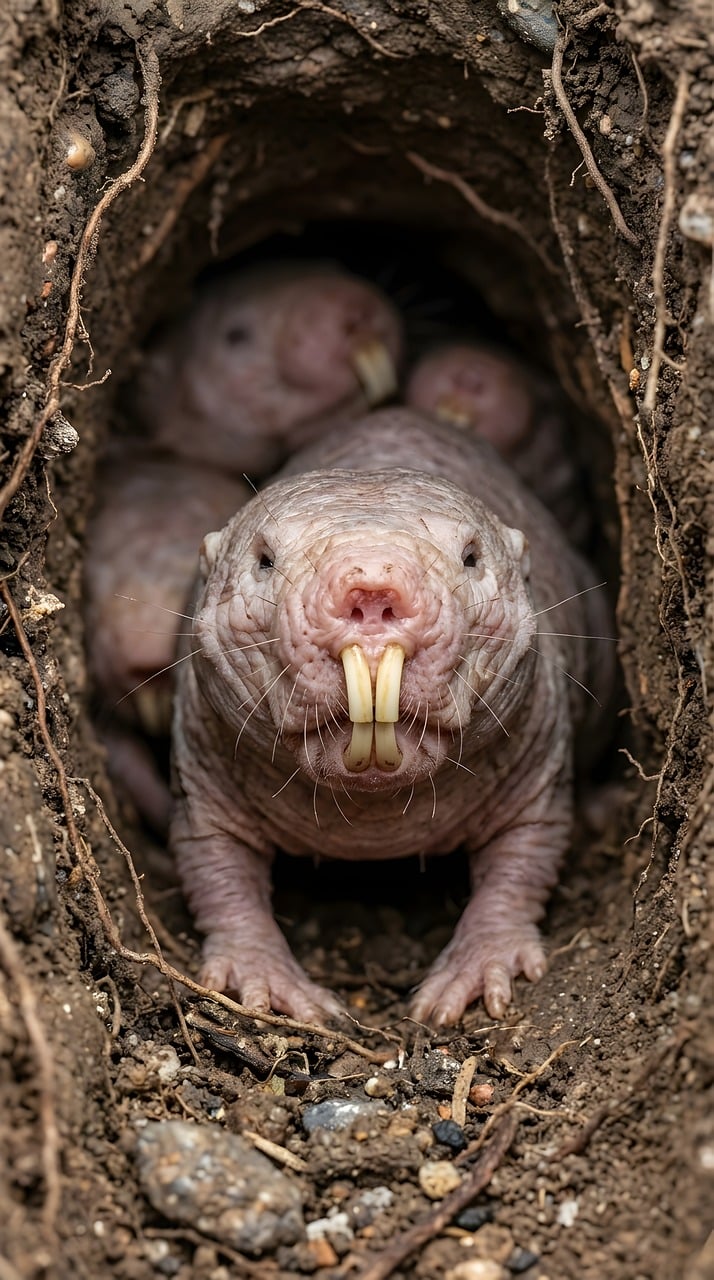
A Naked Mole Rat's Longevity Gene, Transferred Into Mice, Slowed Their Aging
When University of Rochester researchers gave mice the naked mole rat's Has2 gene, lifespan rose, cancer rates halved, and epigenetic clocks read younger. The finding marks the first time a longevity adaptation has been exported across species boundaries.
Give a mouse a naked mole rat’s longevity gene and it doesn’t just live longer. Cancer rates halve. Inflammation drops across liver, muscle, and gut. Epigenetic clocks read younger. The enzyme behind all of it — hyaluronan synthase 2, or Has2 — wasn’t engineered in a biotech lab. Evolution placed it in a wrinkled, nearly hairless rodent that spends its life underground in East African colonies and, for reasons that have stumped gerontologists for decades, shows no signs of aging.
In 2023, Zhang and colleagues at the University of Rochester published a study in Nature reporting a first: they transferred the naked mole rat’s version of the Has2 gene into laboratory mice and tracked the outcome. Has2 encodes hyaluronan synthase, the enzyme that assembles hyaluronic acid — a sugar polymer found in vertebrate connective tissue — into chains. What sets the naked mole rat’s version apart is chain length: its hyaluronan exceeds 6.1 megadaltons, roughly five times the molecular weight of the HMW-HA in mice or humans. As Takasugi and colleagues demonstrated in Nature Communications in 2020, those extra-long chains confer viscoelastic and cytoprotective properties that shorter HA cannot match.
Mice carrying nmrHas2 — the naked mole rat’s version of the gene — gained a 4.4 percent increase in median lifespan. Maximum lifespan in males jumped 12.2 percent. Spontaneous cancer incidence among old mice dropped from 80 percent to 40 percent. Those effect sizes are not subtle. Most longevity interventions shift lifespan by low single digits, and even those numbers attract skepticism. The Has2 results cut through the noise.
“It took us 10 years from the discovery of HMW-HA in the naked mole rat to showing that HMW-HA improves health in mice,” Vera Gorbunova, the Doris Johns Cherry Professor of Biology and Medicine at Rochester and corresponding author, told reporters. “Our next goal is to transfer this benefit to humans.”
Transfer is the operative word. The Has2 approach is transgenic — a permanent genetic alteration, not a molecule anyone can bottle. Hyaluronic acid taken orally or applied topically at the doses in cosmetic and joint-health supplements bears little resemblance to the polymer Gorbunova and Seluanov’s lab engineered into their mice. The vHMM-HA that gives the naked mole rat its cancer resistance has viscoelastic properties that depend on chain length; commercially available HA, typically under 1 MDa, cannot approximate them. Independent longevity researchers have noted that supplement marketing invoking the naked mole rat’s HA story routinely overstates the translational distance. Gene-level manipulation and dietary intake are different interventions, backed by different evidence.
Has2 overexpression in mice is not the only window into the naked mole rat’s longevity. In 2025, Chen and colleagues reported in Science that a second pathway — a cGAS-mediated DNA repair mechanism — helps the species resist age-related damage. Normally, cGAS-STING acts as an innate immune sensor for cytosolic DNA; in most mammals, chronic activation of this pathway drives inflammation. But structural differences in the naked mole rat’s cGAS protein redirect it from inflammatory signaling toward genome maintenance. A pathway that accelerates aging elsewhere gets repurposed into one that slows it.
Taken together, the Has2 and cGAS findings describe a rodent that didn’t settle for one longevity trick. It accumulated several. The naked mole rat lives roughly ten times longer than a similarly sized mouse — captive individuals have reached 41 years — while defying the Gompertz law of mortality, which holds that death risk increases exponentially with age in every other mammal studied. A 2024 analysis by Buffenstein and colleagues in GeroScience confirmed that naked mole rat mortality rates stay flat across decades of adult life, a pattern unseen in any other known vertebrate.
“We already have identified molecules that slow down hyaluronan degradation and are testing them in pre-clinical trials,” Andrei Seluanov, co-corresponding author on the Nature study, said.
Inhibiting the enzymes that degrade HMW-HA, rather than attempting gene therapy, is the nearer-term translational bridge toward human studies. Can a small molecule shift HA molecular-weight distribution enough to recapitulate even a fraction of the Has2 phenotype? Nobody knows. The distance from a transgenic mouse to a human pharmacologic intervention is measured in years, not months.
But the gap now has a floor. Zhang and colleagues’ 2023 experiment established cause and effect — a genetic element that evolution gave one species, transferred into another, altered its aging trajectory. That is not a correlation. It is, as Gorbunova put it, a proof of principle that a longevity adaptation can be exported across species boundaries. After confounding gerontologists for decades, the naked mole rat’s biology is finally becoming legible.
References
- Zhang Z, Tian X, Lu JY, Seluanov A, Gorbunova V. Increased hyaluronan by naked mole-rat Has2 improves healthspan in mice. Nature 621:196-205. 2023. https://www.nature.com/articles/s41586-023-06463-0
- Chen Y, et al. A cGAS-mediated mechanism in naked mole-rats potentiates DNA repair and delays aging. Science 387(6733):824-831. 2025. https://www.science.org/doi/10.1126/science.adp5056
- Takasugi M, et al. Naked mole-rat very-high-molecular-mass hyaluronan exhibits superior cytoprotective properties. Nature Communications 11:3264. 2020. https://www.nature.com/articles/s41467-020-16050-w
- Buffenstein R, et al. Naked mole-rat mortality rates continue to defy Gompertzian laws by not increasing with age. GeroScience 46:3159-3170. 2024. https://link.springer.com/article/10.1007/s11357-024-01201-4
Dean Okonkwo
Molecular biology PhD turned health journalist. Covers aging clocks, NAD metabolism, and the supplement-longevity frontier. Reports from San Francisco.